
In the AI Shift report launched last year, Dscout partnered with DXC to convene a panel of senior design and research leaders from JPMorgan Chase, The Cigna Group, AT&T, Amazon, and Sephora. In this report, we examined how generative AI was reshaping practice at the highest levels of global organizations. Six findings defined the outcomes:
- AI was accelerating execution but raising the risk of sacrificing depth for speed.
- Research was evolving from a reporting function into a strategic force.
- Methodologies were being rebuilt for a probabilistic world where every experience is an edge case.
- Ethical governance and human oversight were emerging as non-negotiable investments.
- Human skills—empathy, judgment, and sensemaking—were becoming more valuable than ever before.
- The roles, team structures, and competencies that organizations had built their practices around were changing faster than most were prepared for.
That report mapped the landscape of the AI shift, but the question that remains is how are organizations actually navigating it? How are leaders restructuring their teams, workflows, and standards in practice? How are they scaling customer-centric thinking across an entire organization without losing the rigor that makes research credible? And as AI moves into all phases of the research—across discovery, conceptualization, validation, and evaluation—how does research as a function need to evolve?
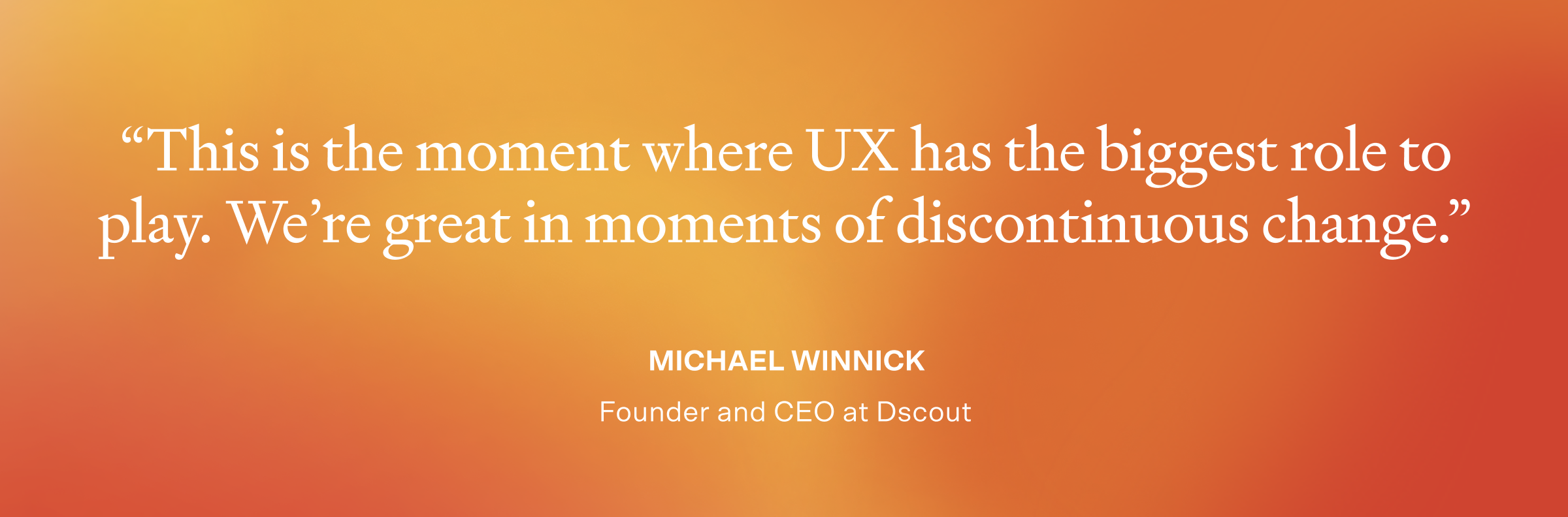
To help answer these questions, we launched a new project with Dscout. As Michael Winnick, Founder & CEO of Dscout puts it,
A more complicated question follows Michael’s insight:
What is the role of research teams when everyone can research?
Think about how the advent of the spreadsheet impacted accounting. It did not eliminate financial expertise. It redistributed access to it and forced experts to operate at a higher level. AI is doing exactly that to research right now. Just as designers today navigate a world where anyone can generate a prototype, researchers now operate in one where anyone can run a study, query a knowledge base, and extract insight at speed. The tools that once defined the research function are no longer exclusive to it.
Traditionally, researchers held domain ownership of user and market research, carrying customer understanding into the organization through workshops, decks, and consultations. That model worked, but it created a fundamental constraint: insight traveled only as far and as fast as the research team could carry it.
Today, the opportunity is different. Organizations that equip every team with the context and capability to act in customer-centric ways transform insight from a mere deliverable into a persistent operating condition. Customer centricity stops being the output of one function and becomes the standard by which every decision gets made.
The floor rises. But a rising floor only creates competitive advantage when someone takes ownership of pushing the ceiling. A DXC member frames the leadership challenge directly:
"When we don't have time for deep discovery, the people who have good judgment rise to the top. How do we build that as a critical aspect of a high-performance team?"
This is the new frontier for research leadership. How will data be managed at scale? Which insights earn curation? How does context hold its integrity inside LLMs and agent-driven workflows? The answers do not live in the tools. They live in the researchers who architect the systems, set the standards, train the agents, and ensure their judgment reaches every corner of the organization without them needing to be in every room.
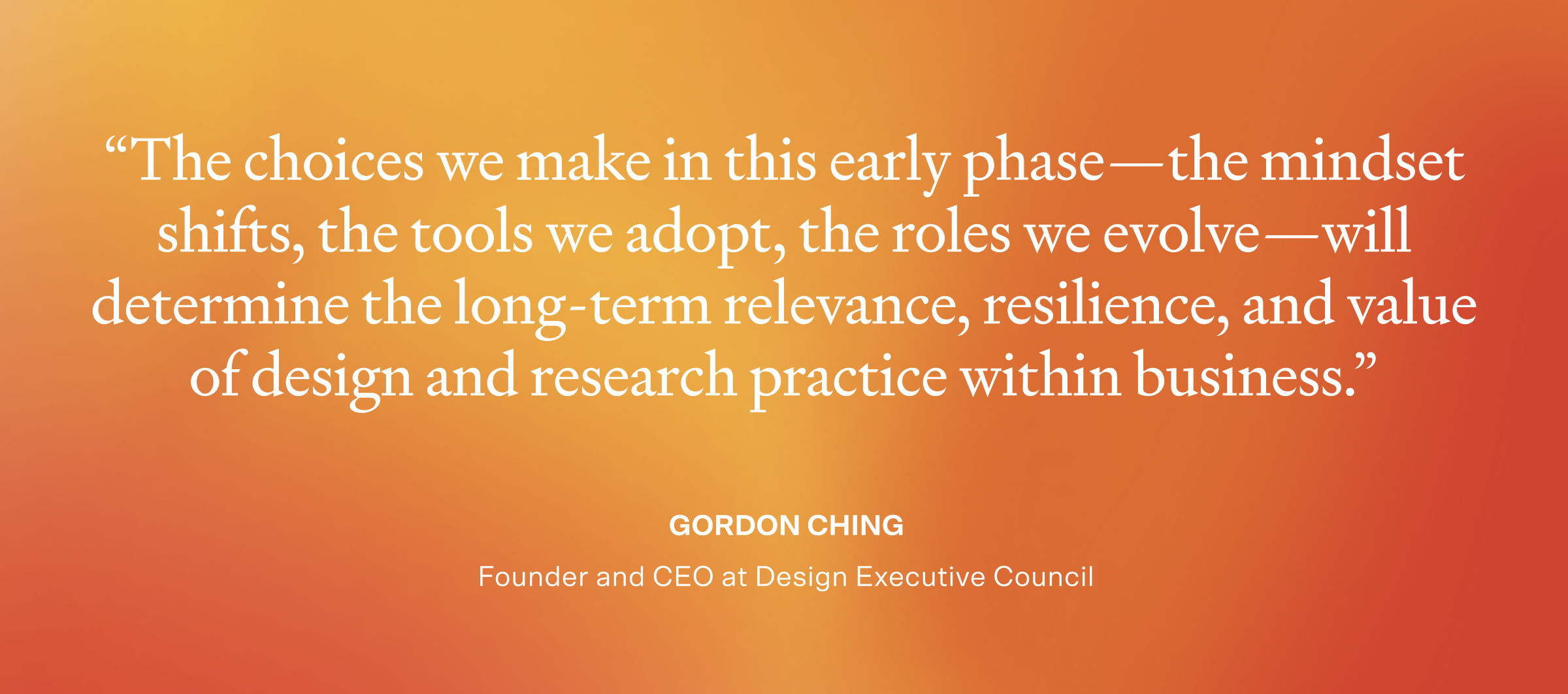
As Gordon Ching, Founder & CEO of Design Executive Council, notes,
This is the AI shift to the left. Research is no longer a downstream checkpoint. It is the upstream architecture and capability that shapes how the entire organization discovers, decides, and builds.
To explore the drivers and determinants of this phase, Dscout and DXC are partnering once again to bring together the senior leaders building this architecture in practice. Across four tracks in Q2 and Q3, we will examine how design and research leaders are navigating this transition:
- Building the research team of tomorrow
- Rethinking capacity with AI in the workflow
- Retaining customer-centricity when everyone builds
- Scaling quality with AI evaluation models
Starting in May, we invite you to join these free virtual webinars live. Each session brings together a small group of senior design and research leaders for a candid, peer-level exchange on what this shift looks like inside real organizations. We look forward to seeing you there.