“You’ve got to start with the customer experience and work backwards to the technology. You can’t start with the technology and try to figure out where you’re going and try to sell it.” — Steve Jobs, 1997
Our 2026 theme is anchored in a deeply human-centric approach, which has regained urgency as generative and agentic AI redefine how work gets done—from how products are built to how customer experiences are delivered. We now live in a world where “making” has been democratized by a prompt, placing the tools of intelligence in everyone’s hands.
However, the democratization of output is not the democratization of insight, taste, and judgement. While anyone can now build, few are equipped to navigate the complex intersection of deep human needs and business outcomes. The volume of ideas, prototypes, and opportunities also grow with this democratization, raising new questions of judgement, agility, and quality.
With near infinite production, the competitive moat is no longer the ability to build—it is the ability to edit, judge, and direct the experience toward meaningful human-centered value. But who will have ownership and accountability for what ensures quality inputs, outputs or outcomes? This context frames our theme of 2026: Unlocking the Experience Advantage.
This year, our Council will focus on these evolutionary opportunities for design executives to set a new foundation with judgement for how user and customer-centricity exists across business processes, now evolved with AI. After our Summit 2025 in Silicon Valley, we defined a key shift from design leadership to experience leadership that represents a critical growth opportunity for design executives to gain greater strategic scope over growing number of elements of the experience strategy, grounded in a human-centric approach, along with the governance, transformation and change management required to realize it.
"There will be a premium for leaders who understand and can anticipate user needs across many use cases—and who can shape the full experience. There is a vacuum here that must be filled." — Suzanne Pellican, Former VP of Ads User Experience at Google
The evolving scope of strategic design leadership
As enterprises face new challenges in defining and governing quality in an age where everyone can make, new leadership imperatives are emerging. This shift creates an opportunity for design executives to evolve from functional leaders into enterprise leaders—guiding the entire product lifecycle and customer journey through human-centered discovery, validation, design, development, launch, measurement, and governance.
This is informed by our 2025 theme that marked the arrival of the Intelligence Renaissance—a shift from intelligence constrained by humans to intelligence distributed through generative, agentic enterprise systems. AI-era dynamics introduce new needs for how customer experience imperatives gain strategic importance in helping differentiate products and services, as well as operational imperatives to create higher-performing operating models that match the pace and complexity of business today. For CDOs, long-standing organizational challenges are being amplified by AI, introducing new risk vectors as intelligence systems increasingly reflect the structure, quality, and decisions of the organization itself.
This raises the questions that matter most for design executive advancement:
- Strategic Readiness: What is the long-term ambition of the business, and does our current organizational architecture have the "experience infrastructure" required to get there with confidence?
- Value Differentiation: Where, and in what specific ways, does experience create a defensible moat that delivers sustained value for customers, employees, and the enterprise?
- Operational Consistency: How are leaders architecting the conditions and operating models in which teams—augmented by AI—consistently deliver high-integrity experiences at scale?
- Accountability Mandate: What new forms of enterprise-level responsibility must design executives take on to bridge the gap between customer-centric intent and bottom-line growth?
- Metrics of Success: What are the new KPIs that measure experience not as a "feeling," but as a structural enterprise capability to drive outcomes?
In 2026, DXC will build on this shift and convert insights into guidance and resources for our membership community—expanding the career pathways for design executives as enterprise-level experience leaders who will be increasingly accountable for performance and outcomes.
“While it’s now easier for all of us to be builders and makers, our roles are evolving into customer and user leaders—guiding the business toward the most desirable outcomes.” —Jeff Gelfuso, SVP, Chief Product & Experience Officer, Qualtrics
We'll invest in clarifying not only how design-led experience leaders operate, but also the direction they must take, the measures required for enterprise accountability, and what distinguishes design executives who can rise into these roles and sustain high-level performance with accountability.
The 2026 roadmap to redefine design and experience leadership
In 2026, DXC is turning this role-evolution thesis into an operational reality through a four-quarter core roadmap designed to help members position for enterprise accountability in the AI era. Our events will also expand to include cross-functional voices from across the enterprise, broadening the dialogue around the opportunities and challenges of stewarding experience leadership as an enterprise capability.
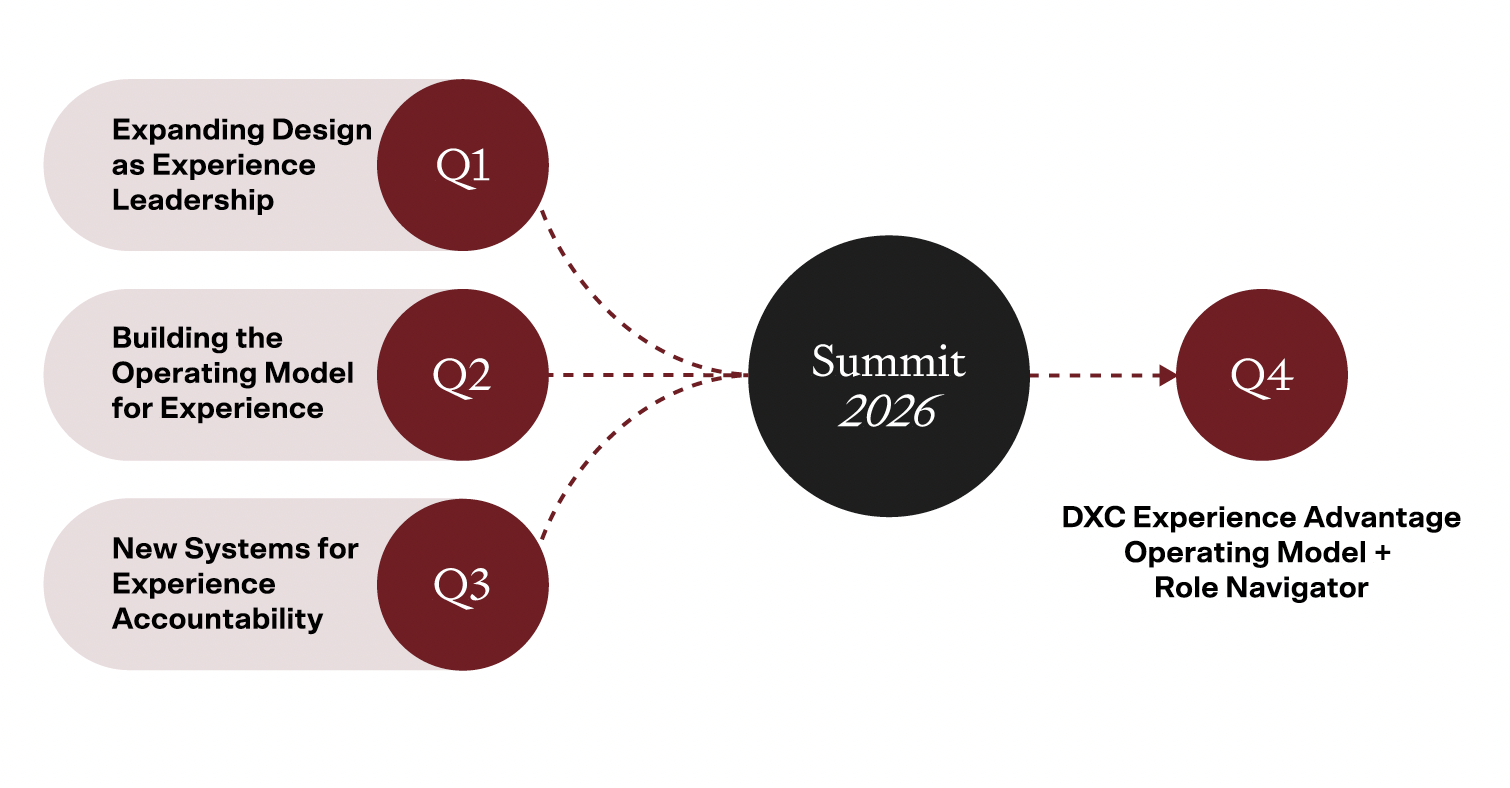
- Q1 | Expanding Design as Experience Leadership: We begin by establishing a new thesis for the value, scope, and authority of the role—defining how design executives must evolve from functional heads into enterprise decision-makers.
- Q2 | Building the Operating Model for Experience: We move into redefining the mechanics of how experience leadership functions inside complex organizations, focusing on new capabilities and ways of working that define how we organize and deliver.
- Q3 | New Systems for Experience Accountability: We deepen our focus on the systems that sustain experience leadership—accountability, measurement, and governance—ensuring outcomes are owned and defensible.
- Q4 | From Framework to Field Use: The year culminates in the definition of the DXC Experience Advantage Operating Model and Role Navigator—a practical tool exclusively for members to navigate the success factors of their roles at increasingly levels of influence and accountability.
If you are a senior design or experience executive at an inflection point—where expectations are rising fast, and more questions arise than answers, we've set up a robust program to address these challenges alongside a group of VP to C-Level design executives of global enterprises in our membership program.
We thank our membership community for their continued engagement and leadership in helping us shape our agenda for 2026 and look forward to a productive year together.