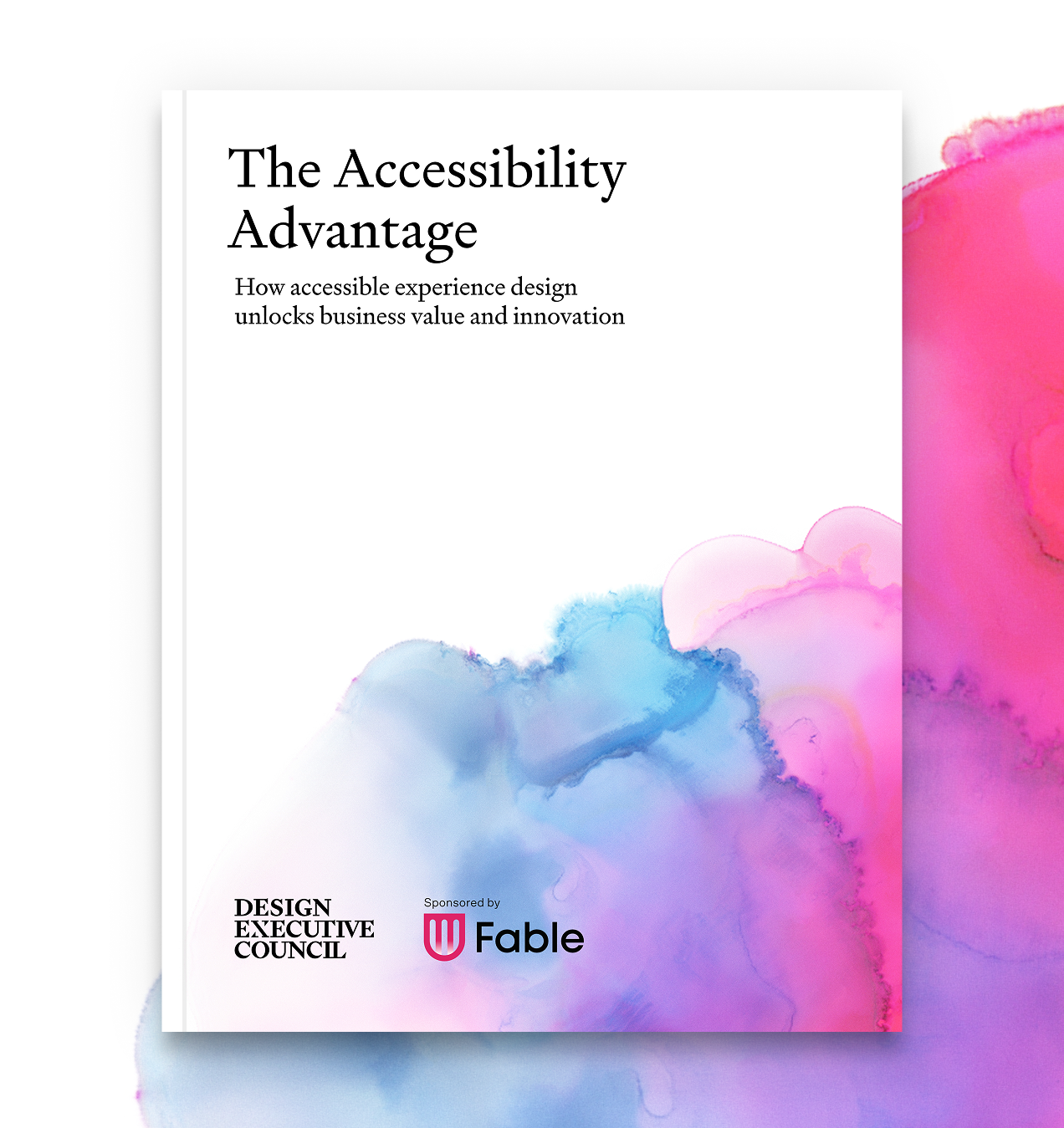
The Accessibility Advantage is an executive case study on how accessibility, when treated as a core business capability, strengthens an organization's ability to innovate, scale, and compete.
Conducted by DXC in partnership with Fable, the report draws on executive interviews with senior UX and accessibility leaders from U.S. Bank, Warner Music Group, Target, and The Cigna Group. These global enterprises span financial services, entertainment, retail, and health, with annual revenues ranging from $5B to $270B.
The research demonstrates how designing for real-world human variability, not just ideal conditions, builds products that perform more reliably, expand market reach, and earn lasting customer trust. Whether you are establishing your first accessibility program or scaling an enterprise-wide practice, this report offers actionable insights, frameworks, and case studies to communicate the business case for accessibility and its strategic importance in the AI era.

.png)

How accessible experience design unlocks business value and innovation
March 16, 2026
To download and access the full report, become a part of the DXC Council, or log in if you’re a Council member.
The Accessibility Advantage is an executive case study on how accessibility, when treated as a core business capability, strengthens an organization's ability to innovate, scale, and compete.
Conducted by DXC in partnership with Fable, the report draws on executive interviews with senior UX and accessibility leaders from U.S. Bank, Warner Music Group, Target, and The Cigna Group. These global enterprises span financial services, entertainment, retail, and health, with annual revenues ranging from $5B to $270B.
The research demonstrates how designing for real-world human variability, not just ideal conditions, builds products that perform more reliably, expand market reach, and earn lasting customer trust. Whether you are establishing your first accessibility program or scaling an enterprise-wide practice, this report offers actionable insights, frameworks, and case studies to communicate the business case for accessibility and its strategic importance in the AI era.
The conversation around accessibility is shifting. For leading organizations across healthcare, banking, entertainment, and retail, the question is no longer whether accessibility matters. The leaders featured in this report demonstrate how mature accessibility practices elevate product experience, reduce costly rework, increase operational efficiency, and strengthen adoption and customer satisfaction.
This report was created to help design, product, and technology leaders understand what that shift looks like in practice. The leaders featured here have moved accessibility from a compliance obligation to a strategic capability, one that shapes how opportunities are identified, how products are built, and how organizations compete.
In the AI era, the stakes are rising as AI systems build on the experiences that already exist. Organizations that invest in accessibility today are better positioned to ensure new technologies improve usability rather than introduce new friction, and to define what responsible innovation means for the people they serve.
How accessible experience design unlocks business value and innovation
The Accessibility Advantage is an executive case study on how accessibility, when treated as a core business capability, strengthens an organization's ability to innovate, scale, and compete.
Conducted by DXC in partnership with Fable, the report draws on executive interviews with senior UX and accessibility leaders from U.S. Bank, Warner Music Group, Target, and The Cigna Group. These global enterprises span financial services, entertainment, retail, and health, with annual revenues ranging from $5B to $270B.
The research demonstrates how designing for real-world human variability, not just ideal conditions, builds products that perform more reliably, expand market reach, and earn lasting customer trust. Whether you are establishing your first accessibility program or scaling an enterprise-wide practice, this report offers actionable insights, frameworks, and case studies to communicate the business case for accessibility and its strategic importance in the AI era.
Each attendee is selected for their role in shaping tomorrow’s organizations. Request an invitation to take part in candid, forward-looking conversations that define what’s next.